
Editor,
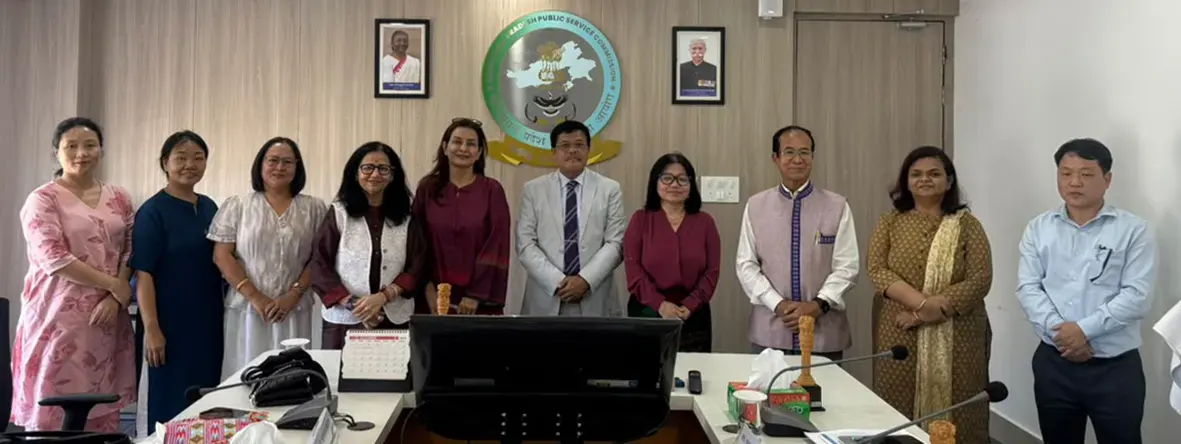
The recent interaction between the Haryana Public Service Commission (HPSC) delegation and the Arunachal Pradesh Public Service Commission (APPSC) is an encouraging development for the state's recruitment system. It is particularly commendable that the chairman and the secretary of the APPSC have demonstrated a willingness to engage with other commissions, exchange institutional practices and remain open to reforms.
The chairman's recent announcement regarding the proposed rationalisation of optional subject marks is especially encouraging. Recognising the concerns surrounding variations in optional subject evaluation and expressing an intention to address them is an important step towards ensuring greater parity among candidates. Aspirants are now eagerly looking forward to the commission's formal notification outlining the proposed mechanism and its implementation.
The willingness of the commission's leadership to acknowledge these concerns deserves appreciation.
The APPSC's efforts towards improving transparency, digitisation, grievance redressal and examination procedures are important steps towards strengthening public confidence.
However, institutional reform should not be viewed as a destination but as a continuous process. As the commission moves towards strengthening its institutional credibility, it is equally important to examine certain existing practices and explore further improvements.
1. Making exam regulations practical and proportionate
During the previous APPSCCE Mains examination, candidates were instructed to use transparent pens. While the intention behind such instructions may be to ensure examination security and prevent malpractice, the necessity of restricting candidates to a particular type of writing instrument deserves reconsideration.
Candidates are required to write approximately 20,000 words across multiple papers, making writing comfort an important practical consideration. Candidates should be allowed to use any standard, approved ballpoint or gel pen of their choice, subject to reasonable examination security guidelines. The objective of examination regulations should be to prevent malpractice without imposing unnecessary restrictions on candidates.
2. Reconsidering the weightage of the personality test
The allocation of 275 marks to the personality test warrants a broader discussion. While assessing personality, communication, judgement and administrative suitability is essential, such a substantial weightage gives the interview considerable influence over the final merit position.
Candidates with prior professional exposure or greater familiarity with formal interactions may naturally find themselves more comfortable in an interview setting. Similarly, naturally articulate candidates may have an advantage in expressing their thoughts. This does not necessarily translate into greater administrative aptitude or potential. Equally qualified candidates may consequently experience substantial differences in their final rankings due to variations in interview assessment.
A reduction of interview weightage to either 50 or 100 marks could be considered, ensuring that the written examination remains the principal determinant of merit while retaining the personality test as an important assessment of suitability for public service. This should ideally be accompanied by structured assessment parameters and consistent evaluation practices.
3. Looking beyond the existing optional subject system
The chairman's initiative to explore an external agency for rationalising optional subject marks is a welcome step. Nevertheless, it may also be an opportunity to examine the examination structure itself.
One possibility is to strengthen the existing moderation mechanism. Another is to consider transitioning towards a common general studies-based syllabus for all candidates, thereby addressing the difficulties associated with comparing performance across different optional disciplines.
Such a framework could incorporate governance, public administration, economy, science and technology, ethics and contemporary issues. For Arunachal, a dedicated component covering its history, geography, society, economy and governance would ensure that future administrators possess a deeper understanding of the state they aspire to serve.
These reforms need not be implemented hastily. They should emerge from expert consultations, comparative studies, stakeholder feedback and an assessment of their long-term implications.
4. An opportunity to become a model for other PSCs
The APPSC has broadly followed the UPSC examination framework. While the Union Public Service Commission provides an important institutional benchmark, examination systems must evolve with changing administrative requirements.
The national debate surrounding optional subject disparities, interview weightage and syllabus relevance demonstrates that these challenges are not exclusive to state public service commissions (PSCs).
Rather than merely replicating the existing UPSC framework, the APPSC could explore innovative examination models suited to its own administrative context. Successful experiments could eventually offer valuable lessons to other state commissions, and even contribute to the broader discourse on civil service examination reforms.
In fact, this is an opportunity for the APPSC to become a testing ground for meaningful examination reforms, particularly at a time when the UPSC examination framework itself is subject to discussions about its future direction.
Conclusion
The ultimate objective of a recruitment examination is not simply to identify candidates who perform well in an examination hall, but to select individuals capable of serving society with competence, integrity and empathy.
The Haryana delegation's visit should therefore be seen as more than an exchange of institutional practices. It presents an opportunity for the APPSC to initiate the next phase of reforms.
The willingness demonstrated by the chairman and the secretary deserves appreciation, and aspirants look forward to seeing these reform initiatives translate into concrete institutional changes.
Transparency must be the foundation, fairness the guiding principle, and continuous improvement the ultimate goal.
An institution earns lasting public confidence not merely by making its processes transparent, but by ensuring that every stage of its selection process remains proportionate, objective and responsive to the aspirations of the people it serves.
Eran Yeager,
Aspiring candidate