Protests for Exam Reforms
By Dhurjati Mukherjee
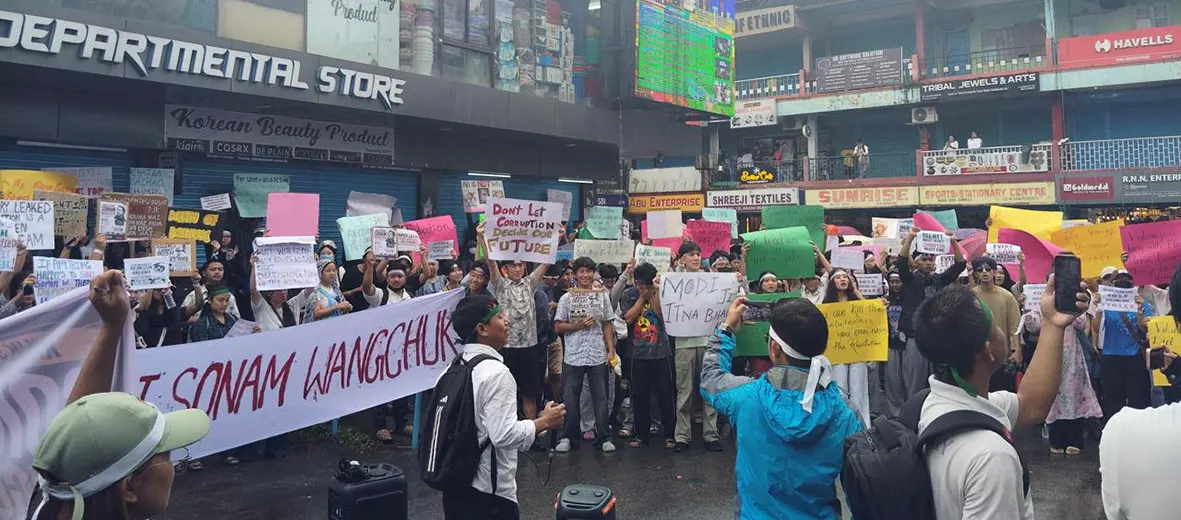
The spread of good medical education is essential for the country as we need more doctors and specialists in various fields. However, government institutions are not expanding to the levels necessary and exams are not being conducted in a fair manner. The recent protests by the Cockroach Janata Party and Sonam Wangchuk and its spilling effect across the country are a reflection of the disillusionment of the young generation with the present political dispensation over question leaks, specially of the all-India NEET exam. Their demands of resignation of Education Minister Pradhan have been met and the Modi government had to relent but the larger question of reforming the exam system looms large. Educationists note the resignation or other measures announced are not enough unless there is a political will and transparency and real transformation in the exam procedure.
While private institutions are meeting needs of the country, the question arises about the fees charged and the quality of education imparted. It’s indeed distressing to note that more than manufacturing, investments in education and hospitals are considered more lucrative as far as profitability is concerned. This has further enraged the student community, most of whom come from the lower echelons of society.
Let’s take note of a recent order of the Supreme Court which stated that private medical colleges cannot be prevented from charging higher fees than government ones and forcing them to do so would result in their closure and harm the spread of medical education. While hearing a plea of an EWS student who was allotted a general category seat in a private medical college where he would be required to pay nearly Rs 19 lakh as annual tuition fee, the two-judge bench noted that such colleges are self-financing. While its justified theoretically, in passing the order the judges ignored the right to education of poor students.
Clearly, there’s a need to look into the facilities the college received from the state government i.e. reduced land prices for setting up the institution. A reservation for EWS category students would thus appear justified. Or else, only those students who come from rich families and have the capacity to pay would get admission in private medical colleges. The order further stated the student to avail scholarships to continue his studies. But is it not necessary the government or the private college are obliged to help a poor student with scholarships?
It is necessary to find out how many students qualify as doctors from the lower segments of society and what government thinks. Moreover, though the order has rightly stated that private medical colleges are self-financing, it would be prudent to find out their cost structure and why they charge exorbitant fees. In fact, there’s a need for government to appoint a committee at the highest level to scrutinise what fees they should charge from students, whether reservation for EWS category exists, scholarships that may be given etc. and submit a report accordingly.
Another interesting order is that of Calcutta High Court which directed the Haldia Institute of Dental Sciences and Research to refund the Rs 9.5 lakh fee of a student, who had enrolled in an MDS course in oral and maxillofacial surgery, as she found the institution doesn’t have proper education facilities. This raises question about quality of education in private medical colleges. While the judgment is laudable, the judge should have directed the institution to upgrade the quality of education and submit a report accordingly.
This brings to light the governance of private medical colleges and quality of teaching. The pay structure of professors needs to be investigated and whether these colleges pay the mandatory honorarium to students during their internship. These need to be fixed by government. It is well-known that most private colleges do not pay internships to students but force them to sign on the dotted line.
The issue of private medical colleges needs to be investigated, and this can only be done if the high-level committee is constituted by the Centre with representatives from some major states. Indeed, the cost of availing medical education in private colleges is much higher in the country as a result of which students prefer to go abroad, specially to China and Russia for such education. This must be discontinued.
Education should not be a profit-making exercise and to curb this tendency, licenses for setting up private medical colleges and nursing homes should preferably be given to doctors on a priority basis and not to businessmen, who are more interested in making money. Doctors should be encouraged to set up these institutions and loans must be made available to them. If corporate houses enter this line, they should give an undertaking of what facilities they would provide for students and people from the lower echelons of society.
As for reservation, as per directives of Supreme Court, there should be no reason why there cannot be reservation of seats for SCs and STs in private medical institutions. Everything cannot be viewed from the context of profitability as we want more doctors to serve in rural and backward areas of the country.
There is a need to examine the whole question of the requirement of doctors in the country. If those who complete MBBS or MDS do not want to serve in rural and backward areas, an expert committee should consider a diploma course of say two years of doctors – preferably from rural backgrounds – to serve in remote areas. We cannot ignore the fact that paucity of doctors and nurses in the country is a severe problem in Third World countries like India, more so with the increase in various types of diseases.
If trained physicians are there to attend to cases in hospitals and rural health centres, the over-crowding in district hospitals would be reduced. As per health ministry data a few years back, India has a little more than 13 lakh allopathic doctors, 5.65 lakh Ayush doctors, translating into a doctor-patient ratio of 1:8334 which is better than the WHO standard of 1:1000. But most of the doctors are concentrated in metros and big cities and in private healthcare system. If the ratio for rural areas is considered separately, the number of doctors per patient would be woefully poor and much below WHO standards.
Mere bringing a bill, however stringent it may be, to stop exam leakages does not solve the purpose, its strict implementation is what is necessary. Meanwhile, it’s welcoming that the National Testing Agency (NTA), which conducts the NEET exam, is being revamped with specialist leadership in cyber security, forensic investigation, test–centre operations and assessment research. This only will be able to bring about the necessary transformation of medical education and of exams per se to ensure that all sections of society get a chance to qualify on merit and no other consideration.
Finally, the government may seriously consider whether para-doctors could be appointed, exclusively to serve rural and backward districts. It is expected that health should not be neglected and more funds allotted for the sector so that the weaker section could derive benefits. A plan must be prepared so that a well-equipped hospital with teaching facilities be set up in each sub-division at the earliest for which the Centre should grant some assistance to the states. — INFA