
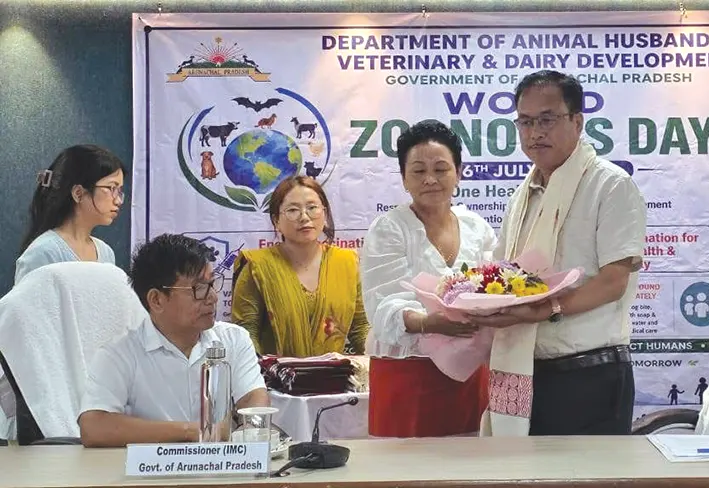
ITANAGAR, 6 Jul: Animal Husbandry, Veterinary & Dairy Development (AHV&DD) Minister Gabriel D Wangsu called for united and sustained effort by government agencies, healthcare professionals, local bodies and citizens to strengthen the ‘One Health’approach for preventing zoonotic diseases and ensuring a healthier and safer Arunachal Pradesh.
The minister was addressing the state-level observance of the World Zoonoses Day 2026 held at DK Convention Centre here on Monday. The programme was organised by the AHV&DDDepartment.
Earlier in the day, Wangsu inaugurated the animal birth control (ABC) centre in Ganga, which will play a crucial role in scientific stray animal population management, rabies prevention, and promotion of animal welfare in the capital region. He also virtually inaugurated the newly established ABC centre in Namsai, extending similar facilities to eastern Arunachal.
On the occasion, the minister released information, education and communication (IEC) materials and launched a weeklong anti-rabies vaccination and animal birth control awareness campaign across the state.
He also administered the public pledge on responsible pet ownership, urging citizens to vaccinate their pets regularly, avoid abandonment of animals, and actively participate in building rabies-free communities.
Addressing the gathering, Wangsu highlighted the historical significance of the World Zoonoses Day, commemorating the successful administration of the world’s first rabies vaccine by Louis Pasteur on 6 July, 1885, which revolutionised disease prevention and continues to save millions of lives worldwide.
“Good health does not begin in hospitals alone. It begins in our homes, farms, villages and forests, where people, animals and the environment coexist. Protecting animal health is, therefore, protecting human health,” the minister said.
Referring to the growing threat of zoonotic diseases, the minister observed that nearly 60 per cent of infectious diseases affecting humans originate from animals, while about 75 per cent of emerging infectious diseases have an animal source. He said that the Covid-19 pandemic demonstrated the urgent need for stronger collaboration among all sectors to prevent future public health crises.
“The lessons of Covid-19 remind us that diseases know no boundaries. No single department can tackle these challenges alone. The future lies in the ‘One Health’ approach, where veterinarians, doctors, environmental experts, municipal authorities and communities work together with a common purpose,” he stated.
The minister also acknowledged the silent yet vital contribution of veterinarians, para-veterinary professionals and field workers in safeguarding public health through vaccination, disease surveillance, food safety, emergency response and livestock healthcare.
“Every time a veterinarian vaccinates a dog against rabies, an entire neighbourhood becomes safer. Their service goes far beyond treating animals – they protect lives, strengthen food security and contribute to the economic well-being of our farmers,” Wangsu said.
Calling upon citizens to become active partners in disease prevention, he urged every pet owner to ensure annual vaccination of dogs and cats, never abandon pets, and seek immediate medical treatment in the event of an animal bite. He further appealed to farmers to promptly report unusual illnesses in livestock, and encouraged communities to support humane management of stray animals through scientific animal birth control and anti-rabies vaccination programmes.
“Government initiatives alone cannot eliminate rabies or other zoonotic diseases. Every citizen has a responsibility. Let us build a society where every pet is vaccinated, every livestock farmer is aware, every child understands how to prevent dog bites, and every community supports human-animal management,” he added.
The programme featured technical presentations by experts on rabies prevention, zoonotic disease surveillance, implementation of the animal birth control programme, the Supreme Court guidelines on stray dog management, and integrated strategies for breaking the chain of rabies transmission through coordinated action.
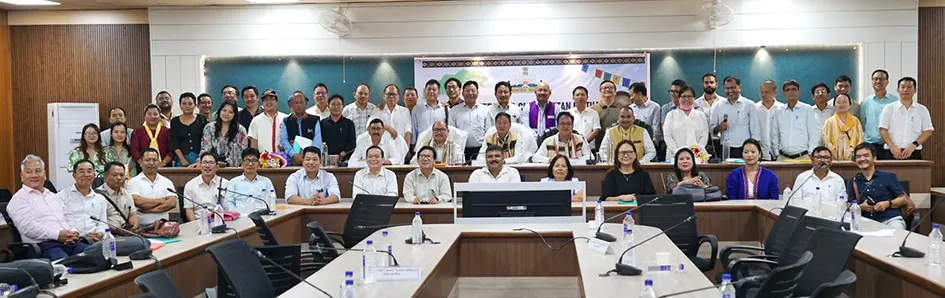
The programme was attended by AHV&DD Secretary YVVJ Rajshekhar and senior officers of the AHV&DD Department, Health Department and the Itanagar Municipal Corporation, besides veterinary and medical professionals, scientists, representatives of partner organisations, students and other stakeholders.
The observance reaffirmed the state government’s commitment to strengthening disease surveillance, expanding anti-rabies vaccination coverage, promoting responsible pet ownership, improving veterinary healthcare infrastructure, and implementing humane animal birth control measures under the ‘One Health’ framework for the welfare of both people and animals.