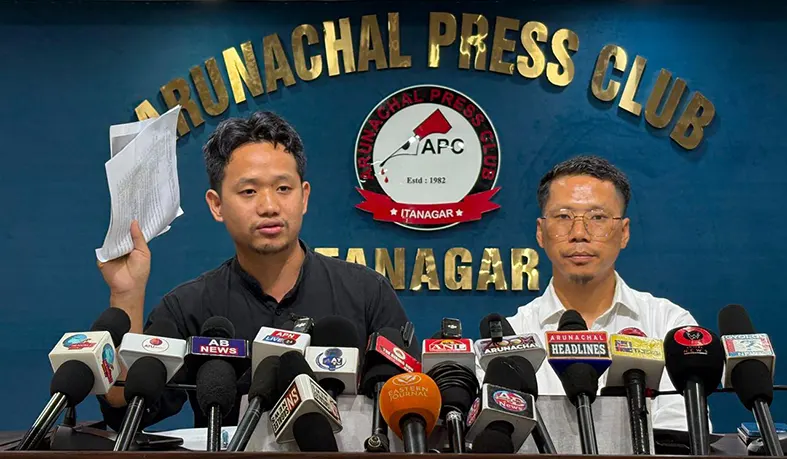
ITANAGAR, 6 Jun: The All Arunachal Pradesh Masjid Welfare Committee (AAPMWC) on Saturday demanded that the Itanagar Capital Region (ICR) district administration adopt a uniform approach towards all religious institutions allegedly operating without proper authorisation, irrespective of faith, and sought immediate unsealing of the mosques recently sealed by the authorities.
Addressing a press conference here, AAPMWC member Giah Limpeh Sultan questioned what he termed “selective enforcement” of regulations, and urged the administration to conduct a comprehensive survey of all religious institutions functioning in the capital region.
The demand comes in the wake of the sealing of several mosques by the district administration on grounds of lack of registration and building permits.
Sultan disputed reports claiming that 15 mosques were operating in the ICR, asserting that there are only six such establishments – three each in Itanagar and Naharlagun. He urged media organisations to verify facts before publishing reports on the issue.
Citing information obtained through the Right to Information (RTI) Act, Sultan claimed that several churches, temples, gurdwaras, namghars and other religious institutions in the capital region have also been functioning for decades without complete documentation or statutory clearance.
“If registration and building permits are the basis for sealing mosques, then the same yardstick should be applied to every religious institution in the region,” he said.
He alleged that the Muslim community was not given adequate time to furnish the required documents, and argued that many mosques operate from rented premises or on land occupied with the consent of landowners through valid agreements.
Sultan further claimed that many religious institutions established during the 1980s were constructed when building regulations were either absent or not strictly enforced. He also cited examples of temples, gurdwaras and namghars which, according to RTI findings, allegedly lack complete documentation.
Appealing for communal harmony, Sultan urged the Arunachal Pradesh Indigenous Youth Organisation (APIYO) not to create misunderstanding among communities, and rejected allegations linking the Muslim community with illegal immigration.
“As an indigenous Muslim, I share the responsibility of safeguarding the interests of local people. However, targeting a particular community is unacceptable,” he said.
The committee warned that if the sealing orders are not revoked and similar standards are not applied across all faiths, the issue could lead to democratic protests and public agitation.