
Three-day HAS conclave concludes
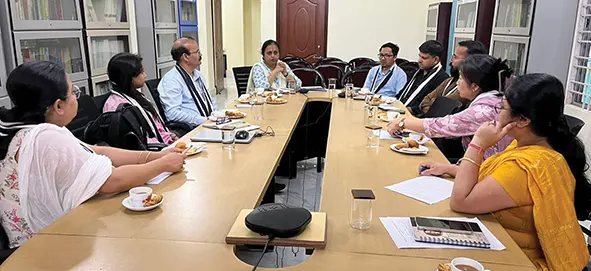
DEHRADUN, 5 Jun: A three-day Himalayan Action School (HAS) conclave, organised jointly by the ActionAid India and Doon University, held at Doon University, concluded on 3 June here on a positive note.
The conclave brought together a diverse group of participants from across the Himalayan region, including representation from Nepal. The discussants came from nine Himalayan states, including government representatives, academics, policy experts, researchers, journalists, civil society organisations, social activists, community leaders, and practitioners working on issues of climate change, natural resource governance, livelihoods, gender justice, and disaster resilience.
Participating in the HAS, Integrated Mountain Initiative (IMI) president Ramesh Negi spoke about how, with increasing privatisation, natural resources are now viewed from the perspective of private interests rather than public interest.
He also stated that, despite policies on housing, health and sanitation, their objectives are not being achieved on the ground.
Participants reaffirmed the need to place local communities at the centre of decision-making.
“Across the Himalayas, mountain communities have developed sophisticated systems for managing forests, water sources, grazing lands, agriculture, and disaster risks. These knowledge systems have evolved over centuries through direct engagement with highly variable mountain environments.
Yet they remain marginal to many contemporary planning processes. A sustainable Himalayan future requires recognising local people not as beneficiaries of development but as custodians, decision-makers, and partners in governance,” Negi said.
Inaugurating the HAS, Uttarakhand State Commission for Women Kusum Kandwal spoke about women bearing the brunt of environmental crises, and emphasised that society must work together to find solutions to natural hazards. She said she looked forward to the opportunity of conveying recommendations from the workshop to the government.
In his address, ActionAid India executive director Sandeep Chachra spoke on the identity and diversity in the Himalayas, underscoring the need to build a shared vision of sustainable futures by the Himalayan peoples.
Former foreign minister of Nepal, Dr Bimala Rai Paudyal, said that balanced development plans must be made, focusing on both development and the environment.
A policy analyst and development strategist from Nagaland, Dr Amba Jamir, spoke about how decisions in the Northeast related to the use and development of natural resources were previously made under a community-based system, and local people had fundamental rights.
Linda Chhakchhuak, an independent journalist from Meghalaya, argued that the Himalayas need more than regulations and environmental safeguards. “They require a living ‘Himalayan Code for Living’, grounded in shared responsibility,” she said.
Widely supported by the participants, the idea calls for a framework that guides how governments, businesses, communities, and individuals interact with mountain ecosystems. At its core is the recognition that the Himalayas are a fragile living system, not an inexhaustible resource frontier. Such a code would redefine development by prioritising ecological resilience, protection of water, forests and biodiversity, community wellbeing, and the rights of future generations.
The call emerging from the HAS was highlighted as being practical and moral. The region urgently needs a shared Himalayan Code for Living- that combines ecological wisdom, community knowledge, democratic participation, and social justice, the participants said.
Such a framework would not only help reduce future risks but also offer a pathway towards a more resilient, equitable, and sustainable Himalayan future, they said.
Discussions also underscored the need to preserve and revitalise traditional ecological knowledge. Indigenous institutions, customary laws, community-managed forests, traditional water systems, and locally developed innovations contain valuable lessons for sustainable living. Far from being relics of the past, these systems may offer critical guidance for navigating an uncertain climatic future, the participants opined.
The need to prioritise resilient local economies was another theme emerging from the proceedings. Participants at the Action School repeatedly highlighted the importance of strengthening mountain agriculture, pastoral systems, forest-based livelihoods, medicinal plant cultivation, women-led enterprises, and local value addition. These sectors not only provide livelihoods but also help maintain ecological balance. In contrast, development strategies that depend excessively on extractive industries and externally driven investment often create ecological degradation while generating limited local benefits, informed the IMI president in release.