
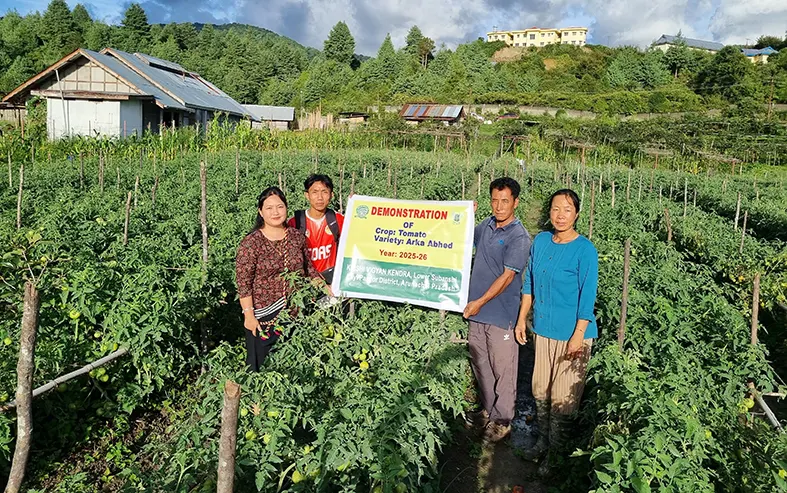
ZIRO, 14 Jul: Farming in the humid, high-rainfall hills of Lower Subansiri district has never been easy. For years, tomato growers have battled erratic weather and devastating plant diseases that could wipe out entire harvests overnight. But today, a quiet agricultural revolution is taking root in the district, thanks to a remarkable new tomato variety called ArkaAbhed.
Introduced to the region by the Lower Subansiri Krishi Vigyan Kendra (KVK), this high-yielding, disease-resistant variety has quickly become a favourite among local farmers, transforming fields and breathing new life into the local agricultural economy.
The journey began in 2023, when KVK scientists set up on-farm trials to see how the variety – originally developed by the Indian Institute of Horticultural Research – would handle the unique, challenging climate of Arunachal Pradesh. The results were so undeniable that by the 2024-25 season, KVK scaled up to frontline demonstrations, taking the seeds out of trial plots and putting them directly into the hands of local farmers.
What makes ArkaAbhed a genuine game-changer for the community is its sheer resilience. It is uniquely armed with ‘four-way’ resistance against the region’s most frustrating crop killers: tomato leaf curl virus, bacterial wilt, early blight, and late blight.
For the average farmer, this means peace of mind. By naturally resisting the blights that thrive in humid hill climates, the variety has drastically cut down the need for expensive chemical sprays. Farmers are spending less money on pesticides, saving gruelling hours of labour, and growing a much cleaner, safer product for consumers.
The financial rewards have been equally striking. ArkaAbhed boasts a massive yield potential of 70 to 75 tonnes per hectare. The tomatoes themselves are firm, beautifully shaped, and weigh around 90-100 grams. Because they are so firm, they have an exceptionally long shelf-life, meaning they don’t bruise or spoil during the bumpy journey along mountain roads to distant markets. Farmers can now sell their produce at premium prices without the constant fear of post-harvest losses.
“For a long time, our farmers were trapped in a cycle of heavy pesticide use just to save their crops from wilt and blight,” said a representative from the KVK. “Watching ArkaAbhed succeed, moving from small test plots in 2023 to thriving, abundant fields this past year, has been incredibly rewarding. It proves that when you give farmers the right, climate-resilient tools, they can completely transform their livelihoods.”
Building on this momentum, the KVK plans to continue its hands-on training and technical support, ensuring that more families across the district can access these high-performing seeds and secure a more prosperous, sustainable farming future.(DIPRO)