Editor,
To outsiders, the Siang River appears merely as a ledger of untapped energy resources - a gleaming spreadsheet listing 11,000 megawatts of generation capacity, seemingly playing a role in distant geopolitical games. But to us Adi people, this river is Ane Siang - our living mother, our history, and the soul of our identity. Every bend in the riverbank, every stone, and every sacred grove speaks to who we are and where we come from.
Yet, the state government remains deaf to this sacred bond. Recently, the Arunachal Pradesh Cabinet decided to form a 'high-level empowered committee', led by Rural Development Minister Okin Tayeng, with local MLAs Alo Libang and Oni Panyang as members. This signals the government's redoubled efforts to push forward with the pre-feasibility report (PFR) investigations. Ministers may establish committees in Itanagar and visit our regions, attempting to package this project as progressive development, but they cannot mask a fundamental truth: this mega-dam threatens to submerge our ancestral lands, sacred burial grounds, and historic villages beneath a vast, stagnant artificial reservoir.
Worse still, the government has adopted a condescending attitude, dismissing the deep-seated fears accumulated by our community over generations as 'misinformation' and 'disinformation'spread by 'vested interests'. This is an outright insult to every Adi elder, mother, and youth who understands the gravity of the situation. When our sacred sites are swallowed by the mega-dam, no bureaucratic meeting, political assurance, or monetary compensation can salvage our cultural heritage.
Since time immemorial, Ane Siang has nourished us; we will never allow her to be imprisoned in concrete to satisfy the demands of distant corporations and the national power grid.
Ecological and livelihood perspectives: The illusion of national security
Central and state leaders repeatedly tell us that the multipurpose projects on the upper Siang River are indispensable 'national strategic assets' - essential tools to counter China's massive infrastructure development upstream. Yet, as farmers, fishers, and long-term residents of this fragile Himalayan valley, we see a terrifying paradox: the government claims to protect us from external threats while creating an internal ecological disaster in our own backyard.
Recent grassroots incidents have exposed the deep conflict between official policy and the livelihoods of local residents. When villagers from Komkar and surrounding areas recently staged fierce protests against proposed drilling and PFR (pre-feasibility report) exploration activities in the Ugan region, they were not acting out of ignorance; they were fighting for survival. The Siang basin lies in a seismically active zone; constructing a mega-project of this unprecedented scale here is akin to a high-stakes geological gamble with the lives of hundreds of thousands of residents living along the basin.
Furthermore, our entire economy relies on fertile paddy fields, community forests, and rich riverine biodiversity. Blocking the river's natural flow would destroy our local food sovereignty overnight. Although the state government attempts to pacify our youth -promoting 'sustainable hydropower' through targeted outreach and school exhibitions - our paddy fields still face the very real threat of destruction and man-made flooding.
True national security cannot be built upon the ruins of local food-producing regions and environmental devastation. If our land turns to dust, even a distant power grid cannot feed our children.
Democratic rights and militarisation: A survey conducted under surveillance
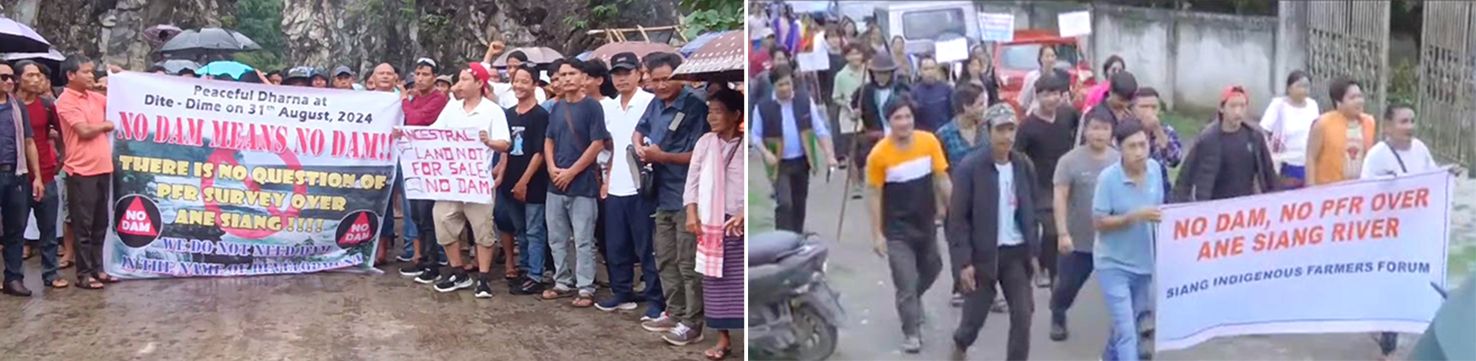
A project that genuinely claims to benefit the people would not require such heavy security measures just to get off the ground. Yet, in villages across Siang and Upper Siang districts, we have personally experienced chilling intimidation and systematic repression. The deployment of massive security forces to facilitate the highly controversial population and household survey stands in stark contradiction to the government's rhetoric of 'consultation and consent'. When community organisations like the Siang Indigenous Farmers' Forum (SIFF) and ordinary villagers peacefully stand up to protect their land, they are branded as hostile agitators. Local voices and advocates who dare to question the official narrative face immense bureaucratic pressure and scrutiny.
Meanwhile, a newly formed high-level committee attempts to manipulate public opinion, dismissing genuine grassroots resistance as 'misinformation' and using heavy-handed administrative tactics to force through a predetermined outcome.
This represents a grave betrayal of the core principles of grassroots democracy. Investigative teams enter villages under the watch of armed security personnel, completely disregarding the principle of free, prior, and informed consent (FPIC). If the government truly believes that the Adi people support this project, it must immediately withdraw security forces from our villages, cease the malicious smearing of our dissent, and respect our absolute constitutional right to firmly say 'no'. True development respects the dignity of the affected people, rather than relying on coercion and forced intrusions into our homes.
Oten Boli