Himalayas Losing Balance
Shivaji Sarkar
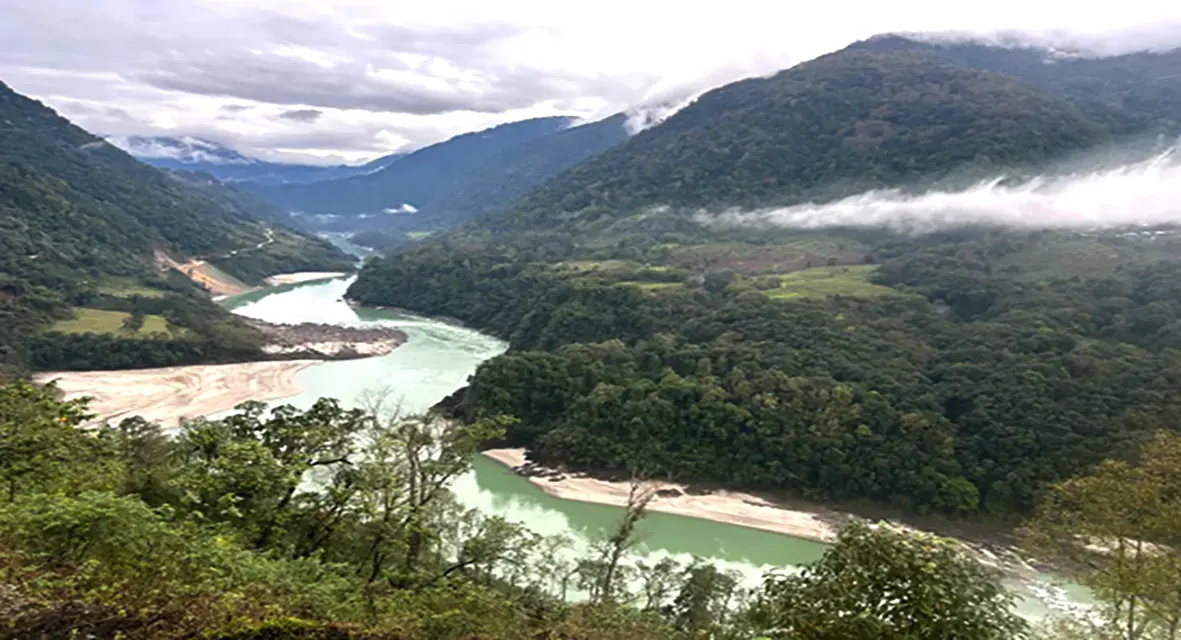
Unfathomable! In a matter of seconds, an immense mass of ice, rock and frozen earth brokeloose high in the Himalayas, unleashing a violent cascade from the Tibetan heights into Nepal. What began at nearly 5,000 metres high became a wall of water, mud, rock and ice racing through the Lhende Khola, Bhote Koshi and Trishuli valleys, tearing through settlements, roads and bridges and radicallyaltering the landscape below.
The sheer force was extraordinary. The collapse produced a seismic signal initially mistaken for an earthquake, while the debris travelled more than 20 km before the flood surged through the Himalayan valleys. Entire riverside settlements disappeared beneath what survivors described as a moving mass of mud and debris. The destruction extended across Tibet and Nepal, with the downstream consequences reaching into India.
But the visible destruction is only the beginning. It is, the geological experts aver, is the beginning of a swifter Indian sub-continental warming as 74 percent of the northernhemisphere permafroststored in Tibet being lost is likely to cause searing heat in Europe, the Atlantic Ocean region extending to Greenland. Would we see many larger icebergs? Likely, but no one knows.
This was not merely another Himalayan flood;it was a geological warning. The Himalayas are a young, restless mountainsystem, increasingly stressed by warming glaciers, thawing frozen ground, unstable slopes and intense human intervention. Roads, tunnels, dams, hydropower projects and expanding settlements are penetrating terrain whosegeology remains inherently fragile.
What makes the disaster particularly disturbing is what cannot yet be seen. A major collapse can destabilise slopes, alter river channels and create or disturblakes, setting off chain of landslides, debris flows and floods. One rupturecan generate another, turning a single catastrophe into a chain of eventsunfolding over years or decades.
And the loss is not merely economic majorly for the subcontinent and particularly a vast swathe of Nepal, Bangladesh and particularly the Indian landmass. A landscape shaped over millennia can be transformed in minutes. Villages, forests, farmland, river courses and ecological systems carry not only material wealth but the accumulated memory of generations. Roads and bridges can be rebuilt; a vanished landscape, ecosystem or cultural inheritance cannot simply bereconstructed.
Nor does the Himalayan disaster end where the mountains descend into the plains. The rivers carry its consequences across borders into Bihar, Uttar Pradesh and beyond, exposing agriculture, settlements, infrastructure and economiesdownstream. What happens at height of 5,000 metres can become a crisis thousands of kilometres away.
The question, therefore, is no longer whether the Himalayas are changing. It is whether the subcontinent/South Asia is prepared for what that change couldunleash— and what generations yet unborn may inherit from our choices today.
It is yet to be assessed how much land would remain agriculturally productive from a limited perspective of Himachal, Uttarakhand, Nepal, northern Bengal, Sikkim, Arunachal and beyond. Perhaps large farmlands would degenerate into sand fields and dunes, many depositions of rubbles and further impoverish the people.
The breadbasket may shrink, hunger could grow in the region and food prices the world over could spike. These are possibilities as indicated by bridge, dam and barrage collapses, including the mighty Farakka leading to a severe flood in Bangladesh. Damage and losses are incalculable as well as not limited to timeschedule.
Such was the force of the event, it was initially reported as an earthquake of magnitude 4.4. The US Geological Survey later determined the tremor was caused by glacial rock and ice collapsing, registering a magnitude of 5.2.The collapse triggered a huge release of water, mud, rock and ice that thundered down valleys and swept down the Lhende Khola, Bhotekoshi and Trishuli rivers –the Gandak system in India.
The high-speed flash floods careered towards northern Nepalese towns, including areas popular with mountaineering tourists and pilgrims.Horrifying videos from the Gyirong border post, which connects Nepal and Tibet, showedpeople running for their lives as the wall of debris obliterated buildings andswept away lines of transport.
Third Pole Collapse - River Projects Useful?
The Third Pole, as the Himalayas are called, collapse may usher in a severe earth heating from eastern Asia to Europe and Greenland.Power lines under constructions and tunnels of the working of innumerable power projects are choked with engineers, workers and technical teams missing and cars blocking tunnels. Many projects may never be revived. Perhaps it would lead to probes to find whether such schemes are profitable, ecofriendly or at all
useful.
Massive downstream dam and hydropower ambitions in sensitive zones like ArunachalPradesh face severe exposure to sudden upstream high-altitude flooding and mass-destructing events.It has washed away railway stations, roads, offices, markets, and what not for over a week in northern Bihar, andBengal.
Magnitude Surpasses Kedarnath
Deaths are uncountable. Latest estimates say it has surpassed the 2013Kedarnath-Uttarakhand tally of 8000. Perhaps right. It’s in a far wider, higher and more critical area that has shaken the foundation of the Himalayas –world’s roof to floor shaken and now the race to the Nepal to the Bay of Bengalis on.
Many ports and river routes may face disruption, potentially reshaping both the ecology and economics from Nepal to Northeast India. Restoring connectivity would becostly—and harder amid regional geopolitical tensions.
The losses include rare Himalayan flora, expensive medicinal plants, herbs, aromatic, life-saving plants and extremely precious, forget about stones,minerals that are stored for millennia. Does the Ganga water gets its specialityand unique qualities from these preserved soils? None knows and now it wouldnot be easy to establish the link.
Permafrost to Global Warming
Thawing Himalayan permafrost is more than a geological concern. Its release of carbonand methane can accelerate warming, while destabilising slopes and watersystems. The Nepal tragedy exposes India’s vulnerability across its fragile Himalayan states.
At around 17,000 feet, the scale and consequences of the detached ice-rock mass remain uncertain. The Qinghai–Tibet Plateau—the Earth’s Third Pole—holds the world’s largest expanse of alpine permafrost, covering roughly one million sq km and storing enormous quantities of carbon while regulating regional hydrology.
As this frozen system thaws, risks of glacier loss, landslides, floods and further warming increase, with possible implications for Asia’s desertification. A next rupture may be awaiting!
India has a formidable task ahead. Extant institutions like the Planning Commission and entireagriculture and earth sciences system need reorientation requiring billions. Can a strained economy do it? — INFA