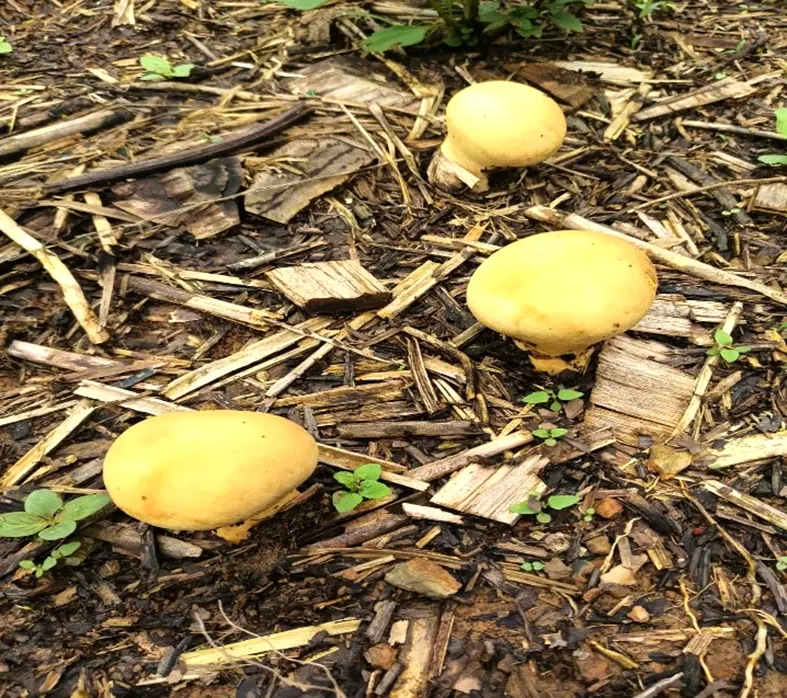
LONGDING, 6 Jun: A team from the Longding Krishi Vigyan Kendra (KVK) recorded a yellow puffball mushroom during a field visit to Zedua village on 4 June.
Based on its characteristic yellow globose fruiting body and puffball-like morphology, the specimen was tentatively identified as Bovista colorata (yellow puffball mushroom) by KVK plant pathology expert Dr Deep Narayan Mishra.
Although detailed microscopic examination and molecular characterisation are required for definitive taxonomic confirmation, a preliminary review of available literature suggests that documented records of this species from Longding district are currently lacking. Therefore, the present observation may represent one of the earliest documented field records of Bovista colorata from the district and a potentially valuable addition to the known macro-fungal diversity of Arunachal Pradesh.
Unlike conventional mushrooms that bear gills beneath a cap, puffball fungi produce millions of microscopic spores within a closed spherical fruiting body. Upon maturity, the internal tissue transforms into a powdery spore mass that is dispersed by wind, raindrops, or physical disturbance, facilitating efficient long-distance dispersal.
Ecologically, the Bovista species serve as important decomposers, contributing to the breakdown of lignocellulosic plant residues, nutrient mineralisation, carbon cycling, and soil organic matter formation. Young puffball mushrooms of several species are known to contain appreciable amounts of protein, dietary fibre, essential amino acids, minerals, and antioxidant compounds.
In addition, studies have reported the presence of bioactive metabolites with antimicrobial, antioxidant, anti-inflammatory, and potential pharmaceutical properties.
Historically, puffball spores have also been used in certain traditional cultures as natural wound-dressing materials because of their moisture-absorbing and haemostatic properties. However, consumption of wild mushrooms should never be attempted without expert identification, as immature poisonous mushrooms can sometimes resemble edible puffballs.
The observation highlights the rich yet underexplored fungal biodiversity of the Eastern Himalayan region and underscores the need for systematic surveys, herbarium documentation, microscopic characterisation, and DNA barcoding of wild macro fungi. Such efforts are essential for understanding their ecological significance and exploring their agricultural, nutritional, medicinal, and biotechnological potential. (DIPR)