
[ Manu Somare ]
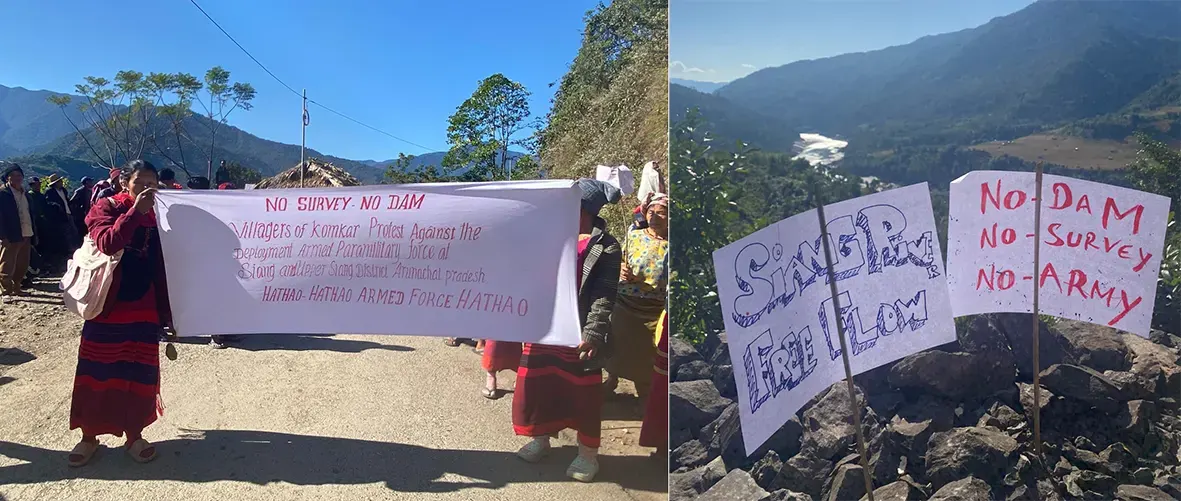
The growing confrontations over the proposed Siang Upper Multipurpose Project (SUMP) has raised fundamental questions about democratic accountability, indigenous rights and the limits of state authority in Arunachal Pradesh. As opposition to the project continues, the reported deployment of security personnel to facilitate pre-feasibility studies has intensified concerns among sections of the local population about consultation, coercion and the future of their ancestral homeland.
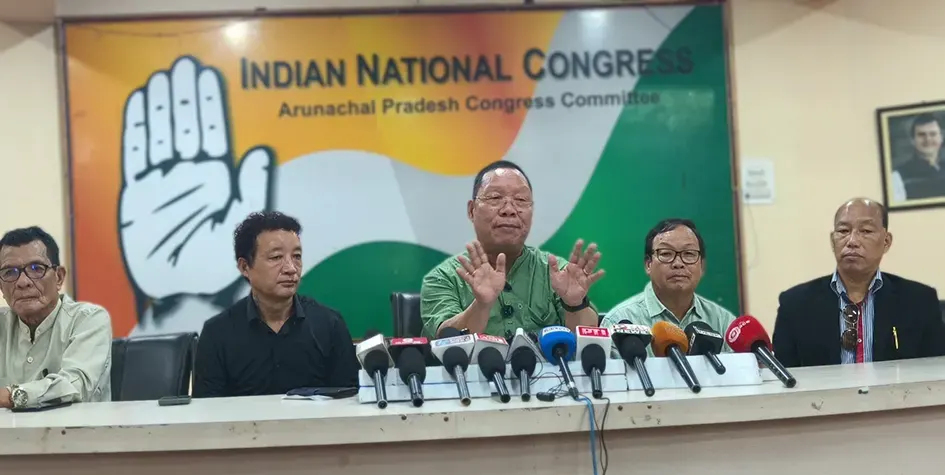
Human rights and anti-mega-dam activist Ebo Mili, addressing students in Pasighat on Sunday brought these concerns into public discussion. His address comes amid reports of heightened security activity in the Siang valley and strong resistance from communities opposed to the proposed project.
The dispute extends beyond hydropower development. At its heart lies a question of political legitimacy: can a project presented as serving national strategic interests proceed in a manner that leaves affected communities feeling that their voices carry insufficient weight in decisions affecting their land, rivers, livelihoods and cultural heritage?
National interest cannot eliminate public accountability
Large infrastructure projects are often justified on the grounds of energy security, economic development and strategic necessity. In a border state such as Arunachal, these considerations may carry particular significance for the government.
However, national interest cannot be treated as an unlimited justification for administrative action. A project's strategic importance does not remove the obligation of public authorities to explain their decisions, comply with applicable laws and protect the rights of the affected residents.
A pre-feasibility study is an early-stage assessment, not a final decision to construct a dam. Yet the manner in which such studies are conducted matters. When survey activities take place amid strong community opposition, the authorities must demonstrate that their actions are lawful, proportionate and accompanied by transparent engagement.
The government must also clarify what the studies involve, what potential impacts are being assessed, and how residents can raise objections and influence decisions before the project advances further.
Security deployment and the question of coercion
Reports of security deployment, confrontations and arrests during the dispute have raised serious concerns about the relationship between law enforcement and peaceful civic opposition.
Security personnel may have legitimate responsibilities in maintaining public order and carrying out lawful duties. Nevertheless, those responsibilities do not place their conduct beyond scrutiny. Any allegation of excessive force, intimidation, arbitrary detention or suppression of peaceful protest warrants an impartial examination of the available evidence.
The relevant questions are concrete: Was force necessary and proportionate? Were arrests supported by lawful grounds? Were detainees afforded their legal protections? Were complaints of mistreatment investigated independently?
If evidence establishes misconduct by individual personnel or officials who authorised or supervised an operation, appropriate disciplinary or legal accountability should follow. Such findings must be based on evidence, rather than assumption. Equally, authorities should avoid treating opposition to a development project as inherently unlawful.
Peaceful disagreement is a legitimate part of democratic life, and residents should be able to express concerns without fear of arbitrary punishment.
Indigenous communities and the right to be heard
For indigenous communities in the Siang valley, the proposed project raises questions that cannot be measured solely in megawatts, construction costs or projected economic returns.
Ancestral land, river systems, forests, agriculture, customary practices and community relationships form an interconnected social and cultural landscape. Large dams can have long-term consequences for settlement patterns, livelihoods, ecosystems and cultural continuity. The scale and likelihood of these impacts must be established through rigorous assessment, rather than speculation or assurances alone.
Meaningful consultation must therefore involve more than informing residents that a project is being considered. It requires accessible information, opportunities to question technical claims, independent assessment of risks, and genuine consideration of community objections.
Where consent is legally required, the applicable requirements must be respected. Even where the law does not provide an unconditional veto over every preliminary study, consultation must not be reduced to a procedural exercise in which decisions are effectively predetermined.
The principle is straightforward: the people who may bear the greatest consequences of a development project must have a meaningful role in decisions that could transform their homeland.
Political responsibility and the conduct of public authorities
The present controversy also raises questions about the responsibilities of elected leaders and senior administrators.
Government officials must explain why the current approach to project preparation is necessary, what alternatives have been considered, and how the rights and concerns of affected residents are being addressed. If authorities have promised meaningful consultation, they should demonstrate how those commitments are being implemented in practice.
A serious accountability process should examine the decisions behind security deployment, the legal basis for arrests, the handling of complaints, and compliance with applicable environmental and consultation procedures. It should also provide a transparent mechanism through which affected communities can submit evidence and obtain responses.
Political responsibility does not automatically establish criminal liability. However, where credible evidence points to misconduct, an independent investigation is essential. Public confidence depends on the willingness of authorities to examine allegations impartially, including allegations concerning their own personnel.
Ebo Mili's address and the wider democratic debate
The reported address by Ebo Mili to students in Pasighat places the controversy within a wider discussion about the rights of indigenous communities and the future of development in the region.
Students and young people have a legitimate interest in understanding how major infrastructure decisions are made, who benefits from them, who bears their costs, and what safeguards exist for affected populations.
Public discussion should be informed by reliable evidence, transparent project documentation and respect for differing viewpoints. Supporting community rights does not require dismissing every argument advanced in favour of hydropower development. Equally, acknowledging national strategic considerations does not require overlooking environmental risks, social costs or questions of accountability.
The challenge is to establish a process in which these competing concerns can be examined openly and fairly.
A call for transparency and a credible process
The government should take practical steps to reduce tensions and restore public confidence.
First, it should publish clear information about the scope, legal basis and objectives of the pre-feasibility studies, together with available environmental and social assessments.
Second, allegations concerning excessive force, unlawful detention or intimidation should be examined through an independent and transparent process. Anyone detained must receive the protections guaranteed under applicable law.
Third, authorities should establish a credible mechanism for consultation that allows affected villages and community representatives to raise concerns, obtain answers from technical experts and receive written responses to substantive objections.
Fourth, the project process should identify potential displacement, environmental damage, livelihood impacts and cultural risks, while making clear what mitigation measures and alternatives are being considered.
Finally, elected representatives and senior officials should communicate directly with affected communities and explain how their concerns will influence subsequent decisions.
These measures would not predetermine whether the SUMP should ultimately proceed. They would establish the conditions under which the question can be debated and decided with greater transparency, accountability and public confidence.
Conclusion: Development must retain its democratic legitimacy
The controversy in the Siang valley is a test of how the state balances strategic ambitions with the rights and interests of its citizens. The government's responsibility is not merely to advance infrastructure proposals but to demonstrate that the process is lawful, transparent and responsive to the people whose lives may be affected.
Where allegations of misconduct arise, they must be investigated. Where communities raise substantive concerns, they must receive meaningful answers. Where public authorities exercise coercive powers, those powers must remain subject to legal safeguards and independent scrutiny.
The future of the Siang valley should not be reduced to a contest between national development and local resistance. A legitimate development process must take both national objectives and the rights of affected communities seriously.
National interest is strongest when it is pursued through public accountability, not at its expense. Development earns legitimacy when the people who bear its consequences are treated not as obstacles to be managed, but as citizens whose voices matter. (The contributor is an independent public-interest advocate focused on indigenous rights, river protection, community participation, and environmental accountability in Northeast India. The views expressed are personal.)